The Challenge
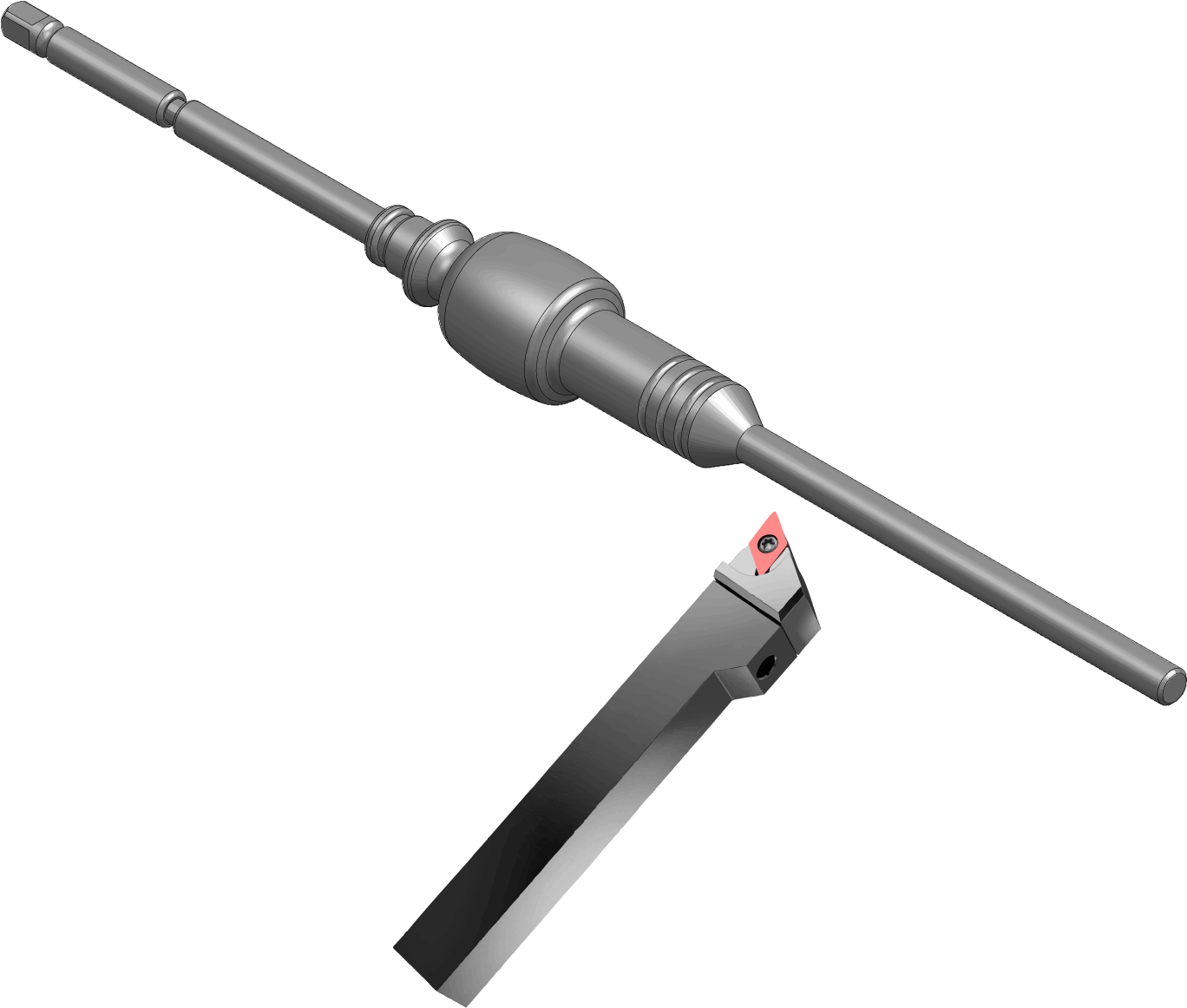
During the turning operation of a medical screwdriver made from Custom® 465, our customer Rudischhauser experienced major issues with their existing cutting tool.
Extremely short tool life of the cutting edge in the roughing process, along with significant dimensional fluctuations, resulted in a high scrap rate.
This martensitic stainless steel material with a high chromium and nickel content already reached hardness levels of up to 50 HRC in the annealed initial condition and tended to severely work-harden during machining—posing a particular challenge for machining operations. Frequent insert breakages, length deviations of up to 0.6 mm, and insufficient chip control prevented a reliable, stable complete machining process for the component. The result was regular machine downtime and production stoppages.
Neither adjusting the cutting speed nor using special chip-breaking strategies or chip-breaking software led to a sustained improvement in the process.
The Solution
Using the AC5000S series from Sumitomo in combination with the MAS PZ©turn quick-change system achieved the required process stability.
By implementing the AC5015S carbide grade, an eightfold increase in tool life was achieved (56 minutes vs. 7 minutes) compared to the previously used indexable insert. At the same time, part quality remained stable—whereas length deviations of up to 0.6 mm had previously occurred.
By selecting the appropriate MNSL chipbreaker and combining it with a customer-side CAM program optimized for chip control, chip issues were permanently eliminated and tool breakages were reliably prevented.
The Result
Rudischhauser is now producing with a stable and reliable process.
Uncontrollable insert breakages no longer occur, and dimensional fluctuations have been eliminated.